
Eligibility Tool
An easier way to find out where you stand
The same questions an attorney would ask, in plain language and at your own pace. Below is a full walkthrough — the questions, an example analysis, and what happens after an attorney reviews it.
The Eligibility Tool is software, not a lawyer. It does not give legal advice and it does not decide whether you qualify. A licensed attorney reviews every submission and makes every decision.
The questions
Every question the tool asks — nothing hidden
One question at a time, in plain language. No forms, no legal terms, no pressure. The example below shows the full set, exactly as a person sees it.
Step 1
Where you are
- What state do you live in?
- What county?
- How many people are in your household?
- Are you married, and would you file alone or jointly?
Step 2
Income
- What is your gross monthly household income?
- Has your income changed in the last six months?
- Is anyone else in the household contributing income?
- Do you receive Social Security, disability, or other benefits?
Step 3
Debts
- Roughly how much unsecured debt do you carry (credit cards, medical, personal loans)?
- Are you behind on a mortgage, car, or rent?
- On a car loan, what is the interest rate and how many months is the contract?
- Are you repaying a 401(k) or retirement loan, and when does it pay off?
- Do you owe taxes, child support, or student loans?
- Have you been sued, garnished, or had an account levied?
Step 4
Property
- Do you own a home? What is it worth and what do you owe?
- What vehicles do you have, and what do you owe on each?
- What is in your bank and retirement accounts?
- Anything else of significant value — tools, a second vehicle, a business interest?
Step 5
History and goals
- Have you filed bankruptcy before? When?
- Have you transferred or sold property recently?
- What are you trying to protect or accomplish?
- Is there a deadline coming — sale date, hearing, garnishment?
The Eligibility Tool is software, not a lawyer. It does not give legal advice and its output is not an opinion about your case. Only a licensed attorney can tell you whether filing is right for you.
Example analysis · illustrative only
Sample matter — Arizona Chapter 7
A fictitious Debtor, used to show what the analysis looks like. Figures are examples, not current rule values, and every line is presented to an attorney for review.
What the Debtor entered
- State / county
- Arizona — Maricopa County
- Household size
- 3
- Gross monthly income
- $5,940
- AZ median (household of 3)
- $8,133 / month
- Unsecured debt
- $61,400 (cards, medical, one personal loan)
- Home
- $395,000 value / $362,000 owed
- Vehicle
- 2019 sedan — $14,200 value / $9,800 owed, purchased 2019
- Bank / retirement
- $1,150 checking · $23,000 401(k)
- Pressure
- Wage garnishment served last week
Chapter 7 readout
- Income below the Arizona median for a household of 3 — passes the means test at Step 1.
- Homestead equity of roughly $33,000 fits inside the Arizona homestead exemption.
- Vehicle equity of roughly $4,400 fits inside the Arizona motor-vehicle exemption.
- 401(k) is exempt retirement property.
- Flag for attorney: confirm the six-month income window and the garnishment date.
Chapter 13 alternative — with conduit payments
The same facts, run as a Chapter 13 so the attorney can compare options side by side. The mortgage is paid as a conduit through the trustee and the arrears are cured in the plan.
- Plan length
- 36 months (below-median debtor)
- Conduit mortgage payment
- $2,180 / month paid through the trustee
- Mortgage arrears cured in plan
- $6,540
- Vehicle treatment
- Paid in plan — purchased more than 910 days pre-petition, cramdown available
- Trustee fee (est.)
- 9.5%
- Estimated plan payment
- $2,760 / month, conduit included
Sample data for a fictitious Debtor. Nothing here is legal advice, an eligibility determination, or a prediction of outcome. Chapter selection, exemption planning, and plan structure are attorney decisions.
The results page
A results PDF the client can confirm
The questions run inside the BankruptcyTrail.ai eligibility game. At the end, the client gets a results summary as a PDF, confirms their answers are accurate, and the confirmed summary reaches the attorney so the attorney can make the decision.
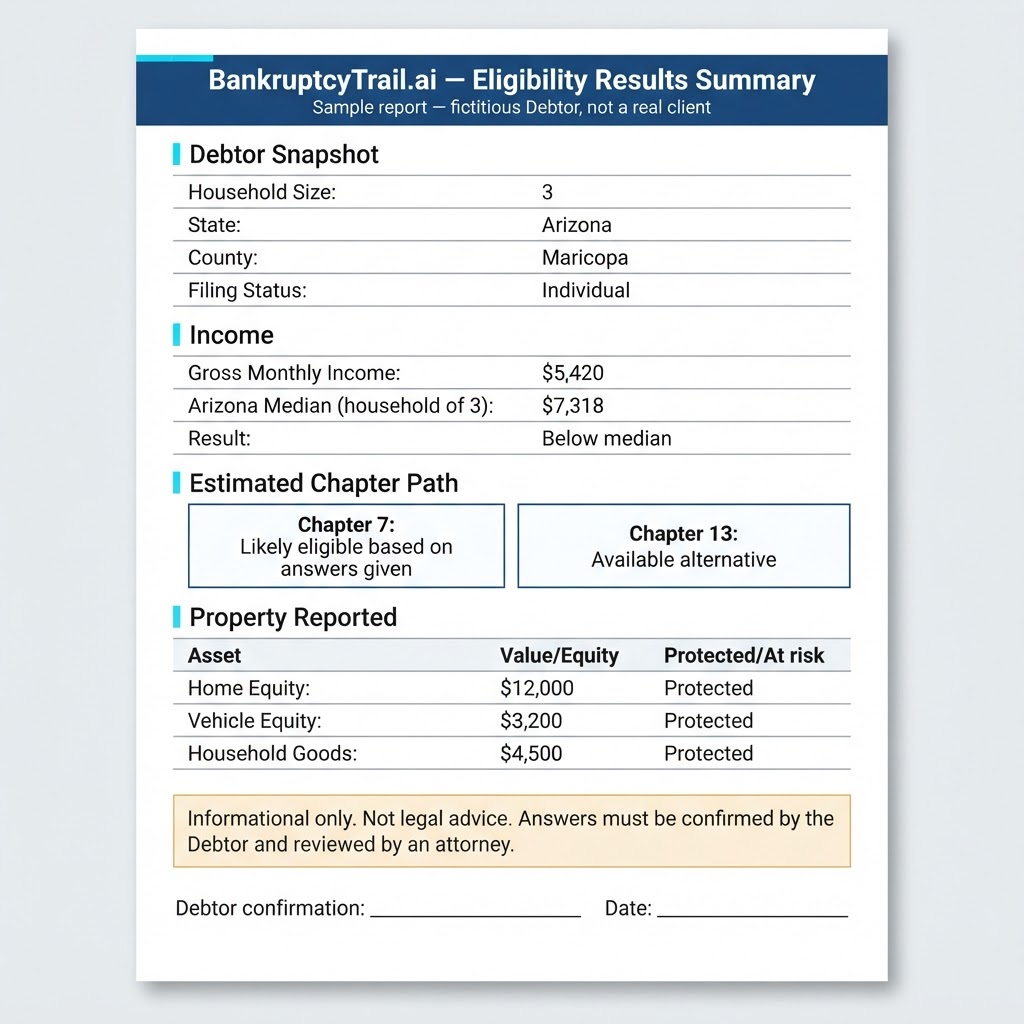
How it reaches the attorney
- The client receives the results page as a PDF they can download and keep.
- They read back through every answer and confirm or correct anything that's off.
- The confirmed summary goes to the attorney, who reviews it and makes the decision.
The results summary is informational only. It is not legal advice and not a determination that anyone qualifies — a licensed attorney reviews the confirmed answers and makes every decision.
Debtor confirmation · four sample matters
The breakdown a Debtor confirms before the attorney decides
Each report breaks out income, assets, and debts, then confirms jurisdiction, venue, and which exemption set applies based on how long the Debtor has lived in the state. Two Chapter 7 examples and two Chapter 13 examples are shown, each with the items flagged for attorney review. The Debtor presses one button to confirm the report is accurate — no client information is recorded by that button.
Debtor A — over median, mostly non-consumer debt
Proposed venue: D. Ariz. (Phoenix Division) — Maricopa County residence 1.9 years
Income
- Debtor gross wages
- $7,450 / mo
- Non-filing spouse contribution
- $1,900 / mo
- Household gross monthly income
- $9,350 / mo
- AZ median (household of 3)
- $8,133 / mo
- Position
- Above median
Assets
- Residence
- $395,000 value / $362,000 owed — $33,000 equity
- Vehicle (purchased 4 months ago)
- $28,400 value / $26,900 owed
- Second vehicle
- $6,100 value / paid
- Checking / savings
- $2,240
- 401(k)
- $61,000
- Tools of trade (closed business)
- $9,500
Debts
- Unsecured consumer (cards, medical)
- $34,800
- Non-consumer (business notes, personal guaranty)
- $188,500
- Secured — mortgage
- $362,000 (current)
- Secured — vehicles
- $26,900
- Priority taxes
- $0
- Consumer share of total debt
- ≈ 15%
Jurisdiction, venue & exemptions
- Time living in current state
- 1 year, 11 months (≈ 700 days)
- Exemption set that applies
- California — prior domicile controls under the 730-day domicile rule
- Homestead protection under applicable set
- Reviewed under CA figures, not AZ
Chapter analysis
- Debts are primarily non-consumer, so the means test under § 707(b)(2) may not apply even though income is above median — attorney to confirm the consumer/non-consumer split.
- Retirement account appears exempt; tools of trade reviewed against the applicable exemption set.
- Vehicle purchased 4 months pre-petition — lien perfection must be checked (date of title/lien recording) before schedules are finalized.
Flagged for attorney review
- • Domicile is 1.9 years — the applicable exemption set is currently California, not Arizona.
- • Within roughly 7 months the applicable exemption set could change as domicile matures. Which set applies materially changes what is protected.
- • Recent vehicle purchase — lien perfection check required.
- • Consumer/non-consumer debt characterization drives whether the means test applies. Attorney review required.
Confirming only marks the report as reviewed. No client information is recorded by this button.
Debtor B — below median, recent vehicle financing
Proposed venue: D. Ariz. (Tucson Division) — Pima County residence 1.9 years
Income
- Debtor gross wages
- $3,980 / mo
- Part-time second job
- $710 / mo
- Household gross monthly income
- $4,690 / mo
- AZ median (household of 2)
- $6,704 / mo
- Position
- Below median — passes at Step 1
Assets
- Residence
- Rents — no real property
- Vehicle (purchased 2 months ago)
- $19,300 value / $21,400 owed (negative equity)
- Household goods
- $4,800
- Checking
- $390
- IRA
- $12,600
Debts
- Unsecured consumer (cards, medical)
- $48,200
- Secured — vehicle
- $21,400
- Priority — none reported
- $0
- Student loans (not discharged)
- $26,000
Jurisdiction, venue & exemptions
- Time living in current state
- 1 year, 11 months (≈ 700 days)
- Exemption set that applies
- California — prior domicile controls under the 730-day domicile rule
- Wildcard / personal property
- Analyzed under CA figures pending the domicile date
Chapter analysis
- Income below the state median for household size — the first step of the means test is satisfied.
- Household goods and IRA appear protected under the applicable exemption set.
- Vehicle purchased 2 months pre-petition — lien perfection check required, and the negative equity affects reaffirmation/redemption options.
Flagged for attorney review
- • Domicile is 1.9 years — California exemptions currently apply.
- • Within roughly 7 months the applicable exemption set could change; timing may change what is protected.
- • Recent vehicle purchase — lien perfection check required.
Confirming only marks the report as reviewed. No client information is recorded by this button.
Debtor C — prior filing bars a Chapter 7 discharge
Proposed venue: D. Ariz. (Phoenix Division) — Maricopa County residence 1.9 years
Income
- Debtor gross wages
- $6,310 / mo
- Spouse gross wages
- $3,150 / mo
- Household gross monthly income
- $9,460 / mo
- Projected disposable income
- $1,980 / mo
Assets
- Residence
- $410,000 value / $371,000 owed — $39,000 equity
- Vehicle
- $16,800 value / $11,200 owed (purchased 4 years ago)
- Checking / savings
- $3,100
- Pension
- $88,000
Debts
- Priority — income taxes (2022–2023)
- $14,600
- Priority — domestic support arrears
- $4,200
- Secured — mortgage arrears
- $9,850
- Secured — ongoing mortgage (conduit)
- $2,240 / mo
- Secured — vehicle
- $11,200 at 24.9% contract rate (cramdown available, >910 days)
- 401(k) loan repayment
- $410 / mo — loan pays off in month 19 of the plan
- Unsecured
- $57,300
- Property settlement / equalization payment to former spouse
- $18,000
Jurisdiction, venue & exemptions
- Time living in current state
- 1 year, 11 months (≈ 700 days)
- Exemption set that applies
- California — prior domicile controls under the 730-day domicile rule
- Homestead equity reviewed
- $39,000 against the applicable set, not Arizona
Chapter analysis
- A Chapter 7 discharge does not appear available — a prior Chapter 7 case was filed within the statutory bar period, so Chapter 7 is analyzed as ineligible for discharge purposes.
- Plan appears able to fund the priority items in full: income taxes ($14,600) and domestic support arrears ($4,200).
- Plan appears able to cure the secured mortgage arrears ($9,850) while paying the ongoing mortgage as a conduit through the trustee.
- Vehicle purchased more than 910 days pre-petition — cramdown treatment available in plan.
- Vehicle contract rate is 24.9%. The plan rate can be reset to the prime-plus formula rate (Till), which materially lowers the amount paid on the vehicle.
- 401(k) loan of $410/mo pays off in month 19 — disposable income rises mid-plan, which can require a step-up plan payment and invite a trustee objection if not addressed up front.
- Equalization / property-settlement payment of $18,000 is subject to review — depending on its characterization it may be dischargeable in Chapter 13. Attorney determination required.
Flagged for attorney review
- • Prior filing affects Chapter 7 discharge eligibility — dates must be confirmed against the docket.
- • High-interest vehicle contract (24.9%) — interest rate reset to the formula (Till) rate flagged for attorney confirmation against the district's rate reference.
- • 401(k) loan drops off in month 19 — mid-plan increase in disposable income must be planned for.
- • Domicile is 1.9 years — California exemptions currently apply; within roughly 7 months the applicable set could change.
- • Equalization payment characterization and dischargeability flagged for attorney review.
Confirming only marks the report as reviewed. No client information is recorded by this button.
Debtor D — Washington home purchased 110 days ago
Proposed venue: W.D. Wash. (Seattle Division) — King County residence 1.9 years
Income
- Debtor gross wages
- $8,240 / mo
- Rental income
- $1,150 / mo
- Household gross monthly income
- $9,390 / mo
- Projected disposable income
- $2,310 / mo
Assets
- Residence (purchased 110 days ago)
- $620,000 value / $498,000 owed — $122,000 equity
- Vehicle (purchased 5 months ago)
- $22,500 value / $28,900 owed — 84-month term at 21.9%
- Checking / savings
- $5,700
- 401(k)
- $142,000
Debts
- Priority — income taxes
- $9,300
- Secured — ongoing mortgage (conduit)
- $3,410 / mo
- Secured — mortgage arrears
- $0 (current)
- Secured — vehicle
- $28,900 financed over 84 months at 21.9%
- 401(k) loan repayment
- $365 / mo — loan pays off in month 26 of the plan
- Unsecured
- $71,800
Jurisdiction, venue & exemptions
- Time living in current state
- 1 year, 11 months (≈ 700 days)
- Exemption set that applies
- California — prior domicile controls under the 730-day domicile rule
- Homestead equity at issue
- $122,000, subject to the recent-acquisition cap
Chapter analysis
- Residence was acquired 110 days ago — well inside the 1,215-day window that caps homestead protection on recently acquired equity. Filing now would expose equity that later filing may not.
- Waiting could help: as the acquisition date ages past the statutory window, the homestead analysis changes materially. Timing is an attorney decision.
- Plan appears able to fund priority taxes ($9,300) in full and pay the ongoing mortgage as a conduit through the trustee.
- Vehicle was purchased 5 months ago and financed over 84 months — because the contract term is longer than the plan term, paying it through a 60-month plan shortens the creditor's term and is a likely objection. Highlighted as a primary objection risk.
- Contract rate is 21.9%. Even without cramdown on the balance, the plan rate may be reset to the formula (Till) rate — attorney to confirm against the district's rate reference.
- 401(k) loan of $365/mo pays off in month 26 — disposable income rises mid-plan, which can require a step-up payment and create feasibility or objection issues if not planned for.
Flagged for attorney review
- • Home acquired 110 days pre-filing — recent-acquisition homestead cap applies; filing date strategy flagged for attorney review.
- • Domicile is 1.9 years — California exemptions currently apply; within roughly 7 months the applicable set could change.
- • Recent vehicle financed over 84 months — plan term shorter than the contract term is a likely creditor objection. Treatment and term flagged for attorney review.
- • High contract rate (21.9%) — formula (Till) rate reset flagged for attorney confirmation.
- • 401(k) loan drops off in month 26 — mid-plan increase in disposable income must be addressed.
- • Venue and jurisdiction confirmed by residence history — attorney to verify against the 180-day venue rule.
Confirming only marks the report as reviewed. No client information is recorded by this button.
All four matters are fictitious and the figures are illustrative, not current rule values. Nothing here is legal advice, an eligibility determination, or a prediction of outcome. Chapter selection, exemption planning, filing timing, lien perfection, dischargeability, and venue are attorney decisions made by a licensed attorney after review.
The attorney decides
The results page ends with a person, not a verdict
The analysis is a summary for the attorney to review. Nothing goes to the client until the attorney presses Accept Case — and the outreach is a scheduling invitation, never an opinion about the case.
Attorney review — sample matter
Debtor · Maricopa County, AZ · Chapter 7 recommended for review
Findings reviewed and initialed by the attorney. Accepting the case releases a scheduling message to the client.
Example client message
Subject: Great news — let's schedule your call
Hello,
Great news — the attorney has reviewed the findings from your Eligibility Tool submission and would like to move forward with your matter.
The next step is simple: schedule a call with the attorney to discuss your options. You'll go over which chapter fits your situation, what happens to your home and vehicle, and the timeline — and you can ask anything you'd like.
Use the link below to pick a time that works for you. Your information and documents stay in your secure portal until then; we'll tell you if anything else is needed.
This message is about scheduling only. It is not legal advice and it is not a determination that you qualify for bankruptcy relief — the attorney will discuss that with you directly on the call.
Where the information goes
Secure intake, stored the way your firm stores things
Information and documents submitted through the Eligibility Tool are delivered to a secure portal, then routed into the firm's storage of choice.
Everything lands in a secure portal
Answers and uploads go straight into the client's secure portal — encrypted in transit and at rest, access limited to the firm. Nothing is posted publicly and nothing is used to train outside models.
Secured cloud storage
Firms that work in the cloud can have submissions routed into their existing encrypted document storage, with folder structure and naming matched to how the firm already files.
Local / on-premises storage
Firms that keep files in-house can have submissions delivered to a local server or workstation directory instead, so records never rest anywhere the firm doesn't control.
Mapped the way the attorney wants
The firm defines the map: which document type goes to which folder, how matters are named, what gets split by chapter, county, or stage. Submissions file themselves according to that map.
All examples on this page use fictitious Debtor data and illustrative figures. Bankruptcy.AI is a technology platform, not a law firm, and nothing on this page is legal advice.